

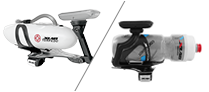
 Most aerodynamic aerobar systems on the market
 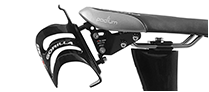 All DELTA Systems include a cage. Match your setup with the perfect carrier.
 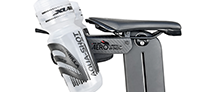 Most widely used brand of dual rear hydration carriers
 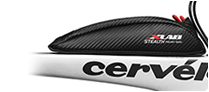 Store your gear in an aero way
 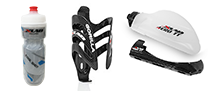 The perfect cage for specific areas on the bike
 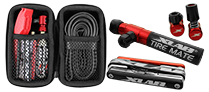 Vital accessories for repair & safety
 AERODYNAMIC DESIGN BY XLAB
We have been obsessed with making bikes faster for over 20 years and have been applying aerodynamic techniques for this whole period.
WHERE ARE THE TARGET AREAS FOR REDUCING DRAG ON A TRIATHLON BIKE?
Over the years we have exchanged many ideas with Cervelo and are pleased to say that we can show you one of the best CFD simulations ever carried out on a complete bike and rider. The chart below shows the low pressure blue areas that are prime for adding accessories while reducing drag at the same time.
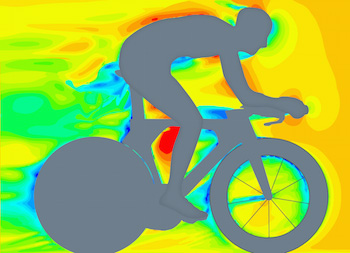
Image courtesy of Cervelo
- Notice the blue area behind the stem. This is where we add the XLAB Top Tube bags to reduce stem drag.
- The blue area behind the saddle is where we have been adding XLAB Rear Bottle carriers since the early 90’s.
- Note also there is some blue low pressure area behind the down tube where we add the XLAB AERO TT aerodynamic bottle.
- There is an even more important area at the front of the bike where drag occurs between the aerobars.
We will show you how we have applied aerodynamic design to Aerobars, Top Tube bags, Frame Bottles, Rear Hydration.
1. HOW WE MADE AEROBARS FASTER TOP
Our challenge was how to reduce the aerodynamic drag of aero bar setups and at the same time add a faster and safer hydration source somewhere in the area of the aero bars. Reducing the aerodynamic drag means reducing the force required to push the aero bars through the air.
WIND DIRECTION
Although it often feels when riding, as though the wind is frequently a headwind, it is more often than not coming slightly from one side.
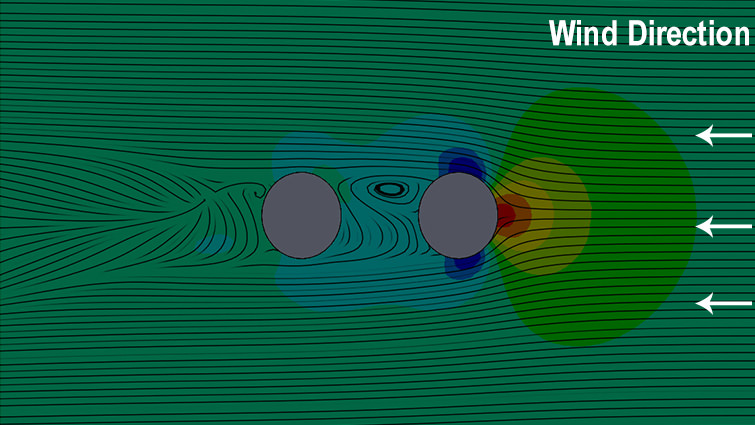
In Figure A below is the Computational Fluid Dynamic (CFD) analysis with the wind coming across the forearms at 20 degrees to the direction of travel. The red and yellow zones indicate high pressure and the blue zones low pressure. You can see that the airflow drops down between the arms and swirls in a turbulent fashion. The drag with this arrangement was 19.3 grams. We could describe this more technically, but we are not out to impress, we are out to communicate how we design and the cutting edge tools we use.
WHITE PAPER - THE AERODYNAMIC DESIGN OF THE ICONIC TORPEDO BOTTLE: XLAB Torpedo Versa CFD Testing
FIGURE A
FILLING THE GAP
Our next thought was to try and fill the gap between the forearms with a standard size water bottle. Figure B shows a CFD simulation of the XLAB AQUA-SHOT bottle between the arms. The airflow now stays mostly above the arms and is reducing the drag compared with no bottle in Figure A. The drag reduced down to 15.2 grams a saving of 21%.
FIGURE B
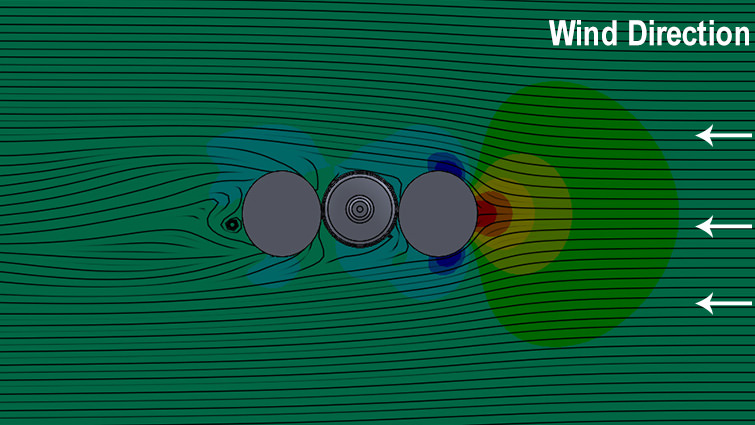
Because of the benefit of reducing drag by adding a bottle horizontally between the forearms we introduced the WORLD’S FIRST HORIZONTAL BOTTLE MOUNT IN SEPTEMBER 2009.
In its first race the XLAB TORPEDO MOUNT with a standard bottle won the 70.3 IRONMAN WORLD CHAMPIONSHIP. The XLAB TORPEDO MOUNT was a resounding success and like most good inventions was immediately copied by other companies.
FILLING THE GAP SCIENTIFICALLY-Designing the TORPEDO Refillable bottle
We knew that a standard bottle was not the ideal shape so we spent several years designing a horizontal bottle that would satisfy some tough criteria.
- Must have at least 60% less drag than a standard bottle.
- Must use a standard XLAB cage so athletes could also carry Standard or Aid Station bottles..
- Must be able to mount a computer in front of the bottle for improved computer aerodynamics.
- Must be able to hold 26 ounces as most standard and Aid Station bottles are 24 ounces.
Figure C shows a standard bottle with a wind speed of 30 mph. The high pressure red and yellow zones are on the front of the bottle and the blue are low pressure areas and the green normalized airflow areas. At 30 mph the drag of the standard bottle was 15.6 grams
FIGURE C
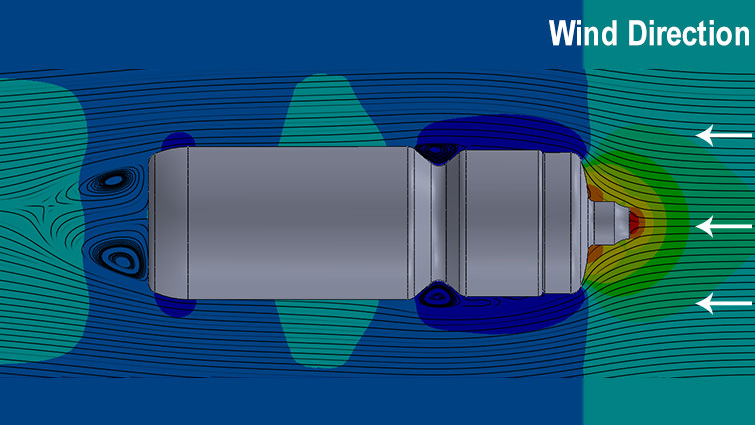
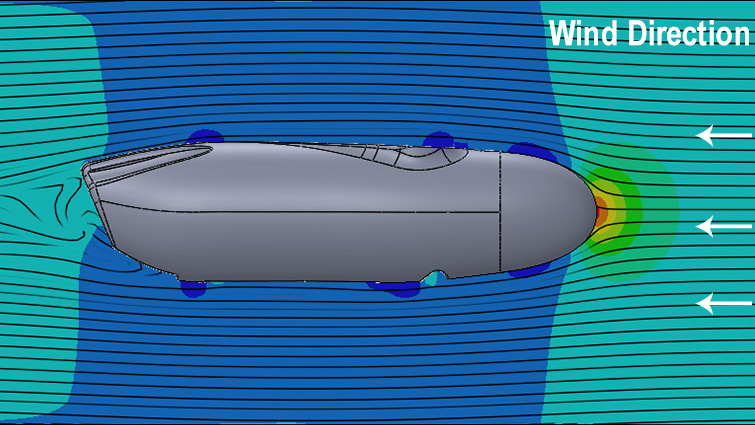
When designing the TORPEDO bottle, it was found that using a Kamm tail design and flow straighteners on the rear section dramatically reduced the drag. It was also important to keep an ideal slenderness ratio which is the length divided by the width. The longer and thinner, the lower the drag and a reduced Coefficient of Drag. Our target was a ratio of 3.75:1 and we actually improved it to be 3.82:1.
Figure D shows the final TORPEDO bottle with drag of only 5.5 grams, an amazing reduction of 64.7% less drag than a standard bottle. When you combine all of the aero factors then the savings at 25 mph are approximately 112 seconds during a full distance triathlon.
FIGURE D
WHITE PAPER - THE AERODYNAMIC DESIGN OF THE ICONIC TORPEDO BOTTLE: XLAB Torpedo Versa CFD Testing
A FEW TIPS HELP MAXIMIZE AERODYNAMIC SAVINGS.
- Ensure that the top surface of the bottle is adjusted to be level with the top surface of the forearms. Use the aero-shaped XLAB spacers for this purpose.
- Ensure the frontal area of the bottle mount is extremely thin like the XLAB Torpedo Mini Mount or have an aerodynamic cross section.
- You want to try and fill the gap between your arms to get the maximum time savings. So position your computer as far forward as you like and then the TORPEDO bottle should fill the rest of the space between your arms. If you have shorter arms use the Space Saver mount and put the computer on top of the bottle.
TOTAL SAVINGS DUE TO XLAB TORPEDO SYSTEMS CAN BE FROM 112 SECONDS AT 25 mph, TO 142 SECONDS AT 20 mph FOR A FULL RACE DISTANCE.
2. HOW TO REDUCE STEM DRAG TOP
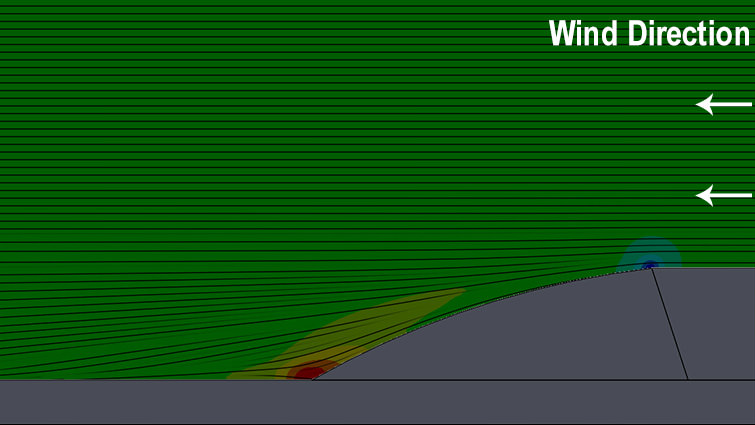
The drag from a stem can be considerable unless the bike is a superbike and the stem is level with the top tube. Figure E shows the airflow at 30 mph coming over the top of a 2.5 inch high stem having a drag of 59 grams.
FIGURE E
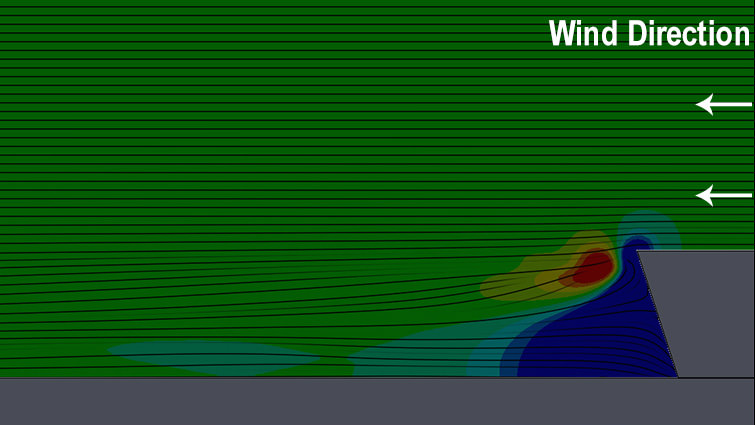
Figure F shows the improvement in airflow and drag dropping down to 1 gram due to the XLAB bag located adjacent to the stem, a reduction of a huge 98.3%.
FIGURE F
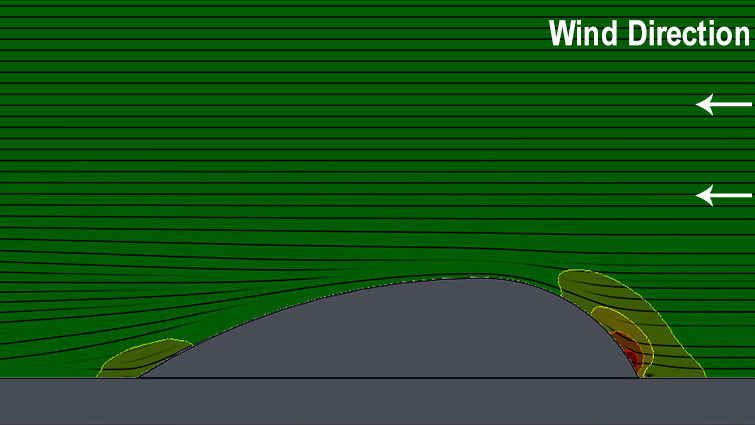
With superbikes and the stem level with the top tube, triathletes can carry nutrition on the top tube with a bag similar to the one shown in Figure G and will have a drag of 5.3 grams at 30 mph.
FIGURE G
USEFUL TIP FOR BAGS ADJACENT TO STEM
Always match the height of the bag to the height of the stem.
TOTAL SAVINGS DUE TO XLAB AERO Top Tube bag CAN BE FROM 123 SECONDS AT 25 mph TO 156 SECONDS AT 20 mph FOR A FULL DISTANCE RACE.
3. HOW TO REDUCE FRAME BOTTLE DRAG TOP
There are three options, Standard bottle, Aero bottle or no bottle. A Standard round bottle’s drag on the down tube with a cage can vary from 40-50 grams of drag. An aero bottle like the XLAB Aero TT will have a drag of 20-25 grams.
TOTAL SAVINGS DUE TO AERO TT BOTTLE CAN BE FROM 51 SECONDS AT 25 mph TO 64 SECONDS AT 20 mph FOR A FULL DISTANCE RACE.
Testing has shown significant savings by moving the bottle to behind the rider. The information below is for just removing the bottle not the additional savings from placing a bottle behind the rider.
TOTAL SAVINGS DUE TO REMOVING BOTTLE AND CAGE CAN BE FROM 96 SECONDS AT 25 mph TO 122 SECONDS AT 20 mph FOR A FULL DISTANCE RACE.
4. HOW BOTTLES BEHIND THE RIDER REDUCE DRAG TOP
The area behind the rider has the greatest potential for drag reduction. We first discovered this in the early 90’s with extensive testing at the San Diego Low Speed Wind Tunnel, regarded as the most accurate tunnel in the nation for bicycle testing. The savings from rear carriers are dependent on the shape of the rider’s back and the positioning of the rear carrier. XLAB developed the Slipstream Vest in order to closely study areas of turbulence by observing the flow of the wool tufts. Recent studies have confirmed what we saw in the wind tunnel.
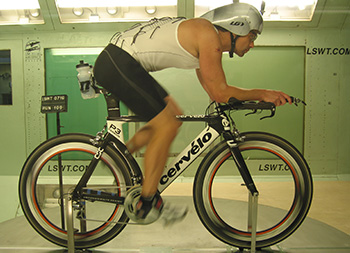
When a rider drafts behind another rider, the rider behind has a reduction in power required due to having less drag as they are riding in the low pressure wake of the rider in front. This can be as high as a 29% reduction. The other result is that the rider in front also goes faster as the air sees the two riders as virtually connected and the airstream jumps the gap between the riders, causing a lower drag on the front rider.
So the idea is to place the rear bottle in the draft of the rider, in other words in the low pressure area usually in the location of the back of the seat/seatpost. One is trying to basically fill in the low pressure void behind the rider. This has been validated in Tunnels all over the world for years but recently reaffirmed with Velodrome testing using the Alphamantis technology with world champions who are able to hold constant aero positions and power outputs.
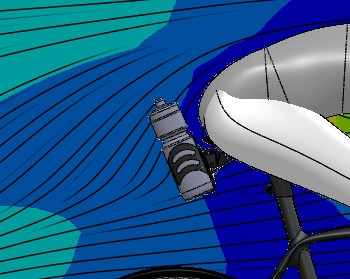
Adding an XLAB Single Rear bottle carrier reduced the full distance race time by 102 seconds (1 min 42 secs) with a 200 watt output. This saving is in addition to the time saved by removing the bottle and cage off of the downtube.
TOTAL SAVINGS FOR ADDING A XLAB Single Rear CAN BE FROM 102 SECONDS AT 25 mph TO 129 SECONDS AT 20 mph FOR A FULL DISTANCE RACE.
SAVINGS SUMMARY CHART
The good news is that the slower you are the more time you will save. Have fun with the data below and choosing which XLAB accessory to try next!
- XLAB TORPEDO SYSTEM ADDED SAVES 112 TO 142 SECONDS
- XLAB TOP TUBE BAG ADDED SAVES 123 TO 156 SECONDS
- XLAB AERO TT REPLACING STANDARD BOTTLE ON THE FRAME SAVES 51 TO 64 SECONDS
- REMOVING STANDARD BOTTLE AND CAGE FROM THE FRAME SAVES 96 TO 122 SECONDS
- XLAB SINGLE REAR BOTTLE SYSTEM ADDED SAVES 102 TO 129 SECONDS
TOTAL SAVINGS USING:
- XLAB TORPEDO AEROBAR SYSTEM
- XLAB TOP TUBE BAG
- XLAB Single Rear BOTTLE SYSTEM
- REMOVING STANDARD BOTTLE AND CAGE FROM THE FRAME SAVES 96 TO 122 SECONDS
- REMOVING BOTTLE & CAGE FROM DOWNTUBE
SAVES 7 minutes 21 seconds (at 25 mph) to 9 mins 15 secs (at 20 mph)


